Showing posts with label surveilance. Show all posts

Monday, May 11, 2009

FBI “Going Dark” Program to Use New Surveillance Technology

JASON RYAN
ABC News
May 9, 2009

The release of the 2010 budget request has shed more light on some FBI surveillance programs the bureau is currently developing and testing.

While the FBI has been criticized at times for its slow reforms after the 9/11 attacks, which revealed the FBI did not have adequate computer resources, some of the new programs sound like something out of a high-tech cloak and dagger film.

The budget request shows that the FBI is currently developing a new “Advanced Electronic Surveillance” program which is being funded at $233.9 million for 2010. The program has 133 employees, 15 of whom are agents.

According to the budget documents released Thursday, the program, otherwise known as “Going Dark,” supports the FBI’s electronic surveillance intelligence collection and evidence gathering capabilities, as well as those of the greater Intelligence Community.

Read entire article

Wednesday, April 8, 2009

UK team builds robot fish to detect pollution

Photo
«»1 of 2Full Size

LONDON (Reuters) - Robot fish developed by British scientists are to be released into the sea off north Spain to detect pollution.

If next year's trial of the first five robotic fish in the northern Spanish port of Gijon is successful, the team hopes they will be used in rivers, lakes and seas across the world.

The carp-shaped robots, costing 20,000 pounds ($29,000) apiece, mimic the movement of real fish and are equipped with chemical sensors to sniff out potentially hazardous pollutants, such as leaks from vessels or underwater pipelines.

They will transmit the information back to shore using Wi-Fi technology.

Unlike earlier robotic fish, which needed remote controls, they will be able to navigate independently without any human interaction.

Rory Doyle, senior research scientist at engineering company BMT Group, which developed the robot fish with researchers at Essex University, said there were good reasons for making a fish-shaped robot, rather than a conventional mini-submarine.

"In using robotic fish we are building on a design created by hundreds of millions of years' worth of evolution which is incredibly energy efficient," he said.

"This efficiency is something we need to ensure that our pollution detection sensors can navigate in the underwater environment for hours on end."

The robot fish will be 1.5 meters (nearly 5 feet) long -- roughly the size of a seal.

(Reporting by Ben Hirschler, editing by Tim Pearce)

Monday, March 23, 2009

Internet conspiracy theories abound over Symantec Pifts.exe file

Claudine Beaumont

London Telegraph
March 12, 2009

The file, called Pifts.exe, requests permission to dial out to the internet. But users of Symantec’s Norton Internet Protection software have found it almost impossible to find more information about the file’s origins and purpose, and the situation has led to a rash of rumours on online message boards about the true purpose of the file.

Security experts, however, believe the file is innocuous and does not pose a threat to internet users.

Many users first became aware of the file on Monday, when their internet protection software popped up a warning that Pifts.exe was trying to access the internet. The location of the file pointed to a non-existent folder within the user’s Symantec LiveUpdate library.

Further investigation by some Norton users suggested that the file attempted to dial out to Norton servers in Africa, while others wildly speculated that “Pifts” stood for Public Internet File Tracking system, and was a sinister attempt to monitor users’ online behaviour.

The rumours were further fanned by Symantec’s apparent decision to delete threads related to the issue from its user support forum, leading some web users to suggest a cover-up by the software company.

But security experts have said that early indications show the file is not malicious and is related to Norton’s security products. It has a build date of March 5, suggesting it has only just been created, said Graham Cluley, a security expert with Sophos.

“Pifts attempts to connect to a webserver (stats.norton.com), passing information such as product name, version number and a series of other non-obvious parameters,” he wrote on his blog.

“We feel fairly comfortable in debunking the internet rumours claiming that Pifts might be a rootkit [a tool used by hackers] or a government-sponsored backdoor to spy on the masses.

“We think it’s more likely that Symantec’s programmers simply forgot to properly tag the file as having permissions to perform its functions. Indeed, a private communication from a Symantec employee reassured us that the problem was more likely to be an error by one of their staff, rather than a sinister plot against Norton users.

READ ARTICLE

Saturday, March 14, 2009

Pentagon Seeks Fleet Of Massive DARPA Spy Blimps

Steve Watson
Infowars.net
Friday, March 13, 2009

Pentagon Seeks Fleet Of Massive DARPA Spy Blimps 130309blimp

The Pentagon has announced intentions to launch an entire fleet of giant 450-foot-long airships which will act as a massive airborne radar system providing perpetual surveillance of vehicles, planes and people on the ground.

The Pentagon said Thursday that it intends to spend $400 million to develop a giant dirigible that will operate on hydrogen fuel cells and solar panels, floating 65,000 feet above the Earth for 10 years, reports the LA Times.

The airships will be around twenty times larger than the Goodyear Blimp, giving ground operators the capability of monitoring an area hundreds of miles in diameter at a time with surveillance equipment, such as high-resolution cameras, in addition to the football-field-sized radar antenna.

Although very large, the airships will be invisible to both the naked eye and ground radar because of their distance from the earth, hovering around 12 miles above the ground.

The craft would also operate beyond the range of any hand-held missile, many surface-to-air missiles and most fighter planes.

The airship, named ISIS ( Integrated Sensor Is the Structure), no doubt after the  Ancient Egyptian goddess, is being developed under an agreement between the Air Force and DARPA, the Pentagon’s semi-secret research arm.

Werner J.A. Dahm, chief scientist for the Air Force describes the airship as “constant surveillance, uninterrupted”.

“When you only have a short-time view — whether it is a few hours or a few days — that is not enough to put the picture together.” Dahm said.  

The Pentagon has described the project as a tool to be used over urban battlegrounds abroad. But, like DARPA’S” Combat Zones That See” project, there’s no reason ISIS couldn’t float over major cities such as New York or Chicago without anyone knowing.

A similar program known as WALRUS was effectively killed off by Congress in 2006. However, the ISIS program has been floating around (pun intended) since 2004.

“We will apply this technology to track people emerging from buildings of interest and follow them as they move to new locations,” announced DARPA’s Paul Benda at a conference in March 2004. “Imagine the impact it will have if ISIS tracks the movement of individuals for months. Hidden webs of connections between people and facilities will be revealed.”

In 2006, reports regarding the project resurfaced as DARPA courted defense contractors Raytheon, Lockheed Martin and Northrop Grumman to develop the airships.

The Air Force has signed an agreement with DARPA to develop a demonstration dirigible by 2014.

Thursday, February 5, 2009

Hackers clone passports in drive-by RFID heist

Iain Thomson 
ITNews
February 5, 2009

A British hacker has shown how easy it is to clone US passport cards that use RFID by conducting a drive-by test on the streets of San Francisco.

Chris Paget, director of research and development at Seattle-based IOActive, used a US$250 Motorola RFID reader and an antenna mounted in a car’s side window and drove for 20 minutes around San Francisco, with a colleague videoing the demonstration.

During the demonstration he picked up the details of two US passport cards, which are fitted with RFID chips and can be used instead of traditional passports for travel to Canada, Mexico and the Caribbean.

“I personally believe that RFID is very unsuitable for tagging people,” he said.

“I don’t believe we should have any kind of identity document with RFID tags in them. My ultimate goal here would be, my dream for this research, would be to see the entire Western Hemisphere Travel Initiative be scrapped.”

Research related articles:

  1. China puts RFID tags in a billion ID cards
  2. New York Offers “Enhanced” RFID Driver’s Licenses
  3. New RFID Technology Allows You to be Tracked WITHOUT Your Knowledge
  4. Big Brother’s Plan to Put RFID on Americans
  5. Enhanced Tracking Technology May Propel Adoption of RFID
  6. VeriChip Corp. Takes Downturn in Wake of RFID Caner-Link
  7. Passports will be needed to buy mobile phones in UK
  8. U.S. School District to Begin Microchipping Students
  9. British travellers could be banned from flying to America
  10. Microsoft wants to get under your skin
  11. Rupert Murdoch Firm Hired Hackers To Sabotage Rival, Lawsuit Alleges
  12. Cyber Security Expert: Hackers Planning To Steal Election For McCain

Wednesday, February 4, 2009

Free Google Software Tracks People

John Byrne
Raw Story
February 4, 2009

A new piece of free Google software released today allows people to keep track of each other using their cell phones — and while it’s opt-in, it’s sure to create a privacy firestorm.

CNET, owned by CBS News, debuted the product on the Early Show Wednesday. It’s designed to work on any phone with Internet capabilities — except the iPhone, one of Google’s competitors (Google launched their own phone, Android, for T-Mobile last year).

Latitude "uses GPS systems and what’s called cell tower triangulation to do the job," CBS reports. "The software seeks the closest three cell towers and, with GPS, combines the data to show where someone is."

It’s being marketed to help parents keep track of their children — but commenters at the liberal forumDemocratic Underground note that surreptitious installation could allow girlfriends or boyfriends, or husbands and wives, to track each others’ movements unwittingly.

"What Google Latitude does is allow you to share that location with friends and family members, and likewise be able to see friends and family members’ locations," Steve Lee, product manager for Google Latitude, told CNET. "For example, a girlfriend could use it to see if her boyfriend has arrived at a restaurant and, if not, how far away he is."

Adds Lee, "To protect privacy, Google specifically requires people to sign up for the service. People can share their precise location, the city they’re in, or nothing at all."

A video of the product demonstration follows. More is available here.

Research related articles:

  1. Google Says Privacy Doesn’t Exist
  2. Windows 7 knows where you are
  3. Surveillance software sales soar
  4. Google to Store Patients’ Health Records
  5. Ohio prof develops CCTV people-tracker ‘ware
  6. Video Game Installs Anti-Piracy Software
  7. “Smart” Surveillance System May Tag Suspicious or Lost People
  8. Fingerprint Software Integrated with Medical Marijuana Dispensary
  9. Group Demands Google Stop Keeping Data Against Users’ Will
  10. Japanese group asks Google to stop map service
  11. Google Wants Its Own Fast Track on the Web
  12. CIA and Google Team Up Again For More Spying

Monday, February 2, 2009

Facebook plans to 'offer up' users as marketing tool for corporations

John Byrne
Published: Monday February 2, 2009


150 million users are an appealing lure.

In a move likely to stir privacy advocates' ire, the company's 24-year-old founder and CEO Mark Zuckerberg demonstrated the platform's ability to poll specific groups of users and be used as a marketing tool at the Davos World Economic Forum.

Later this year, Facebook intends to introduces "corporate polls" targeted at certain portions of the user base as a new means of making money.

Zuckerberg's demonstration didn't use corporate sponsors as examples -- instead, he used a more moderated approach, tempting the audience with polls on Obama, Palestine and Israel, "relaying the results back to the audience within minutes."

"Giving consumer brands the chance to use such a wide audience to get a quick response to targeted questions would do away with, or at least reduce their reliance on, expensive and time-consuming focus groups," the Guardian wrote Sunday. "the company has been experimenting with analysis of user sentiment, tracking the mood of its audience through what they are doing online. Such information is potentially very interesting to large brands, which are always seeking to measure what their customers think about their own or competitors' products."

"Zuckerberg said 2009 will be Facebook's 'intense' year as it tries to justify some of the mammoth valuations that have been placed upon it by making some serious revenues through advertising. He was even seen sporting a tie, a sartorial extra which the Harvard drop-out has so far eschewed," the paper added.

Massive social networking and social news services -- such as Digg, Twitter and Facebook -- are increasingly attempting to capitalize on their large user bases and prove profitability. A deal to sell Digg in the purported neighborhood of $200 million fell through last year after vetting by Google.

Facebook's technology already allows advertisers to target specific categories of users, in much the same way that Google allows companies to target users based on keywords. The site is said to be logging an additional 450,000 users a day.

Polls are expected to launch broadly in the spring, and have been tested by companies like AT&T and Careerbuilder.com.

AT&T is already the target of privacy advocates; a company whistleblower alleges that the company hosted an National Security Agency spy room and allowed the agency to tap into its network to track phone calls. 

Saturday, January 31, 2009

New RFID Technology Allows You to be Tracked WITHOUT Your Knowledge

Louis Sirico
Industrywizards
January 18, 2009

By invitation, I recently visited a remote facility in northern Virginia to see a demonstration of NOX – a new Intelligent Perimeter Defense system deployed by the FBI that uses covert Radio-Frequency Identification (RFID) technology to track people and assets without their knowledge.

That’s right, using RFID to track people without their knowledge. This system is exactly what the privacy advocates have long feared: Big Brother tracking us with spy chips. As Orwellian as this sounds, the undisputed fact is that this system catches thieves and does so at a fraction of the cost of traditional security solutions.

NOX combines high-resolution video pictures and RFID for identification, tracking and tracing, overlaid in real time on a facility map to show the movement of people and assets. The system allows security officers to see theft as it happens, even if the stolen object is inside a briefcase, under a jacket, or stuffed inside a sock.

What makes the NOX system I saw different from traditional security systems is that it uses RFID for clandestine surveillance: RFID readers are hidden inside walls, floors, and ceilings; RFID tags are discretely placed; and only the security personnel know that the system is in place – until the thief gets caught. Then, all the thief knows is that he or she was caught in the act, on video.

"It takes a criminal twelve seconds to defeat a lock or fence. Yet, we spend hundreds of thousands of dollars to create fences that only provide an illusion of security. NOX creates a virtual perimeter that tells us who is penetrating the perimeter, when they are doing it and, where it’s happening. With this information, we can respond with the appropriate level of force and prevent further penetration."
       
A commander with the Naval Criminal Investigative Service (NCIS), who asked to remain anonymous for this article.

There is serious motivation behind the development of NOX in both the government and private sectors. The reality is that traditional security systems are simply not proving to be effective against criminals. Beyond the obvious homeland security concerns, the NOX team places strong emphasis on the impact to our national economy. According to the American Management Association, 95 percent of all businesses are victimized by employee theft. Employees steal over a billion dollars a week from their employers and it takes $20 billion dollars in sales every week just to cover the losses. That’s a yearly economic impact of one trillion dollars. Yet, most companies are embarrassed to talk publicly about how serious this issue really is. They try to deal with it quietly by spending money on traditional security systems. The most shocking statistic is that even with all the money companies spend on security, 80 percent of all employees will be tempted to steal if given the opportunity, according to the FBI.


chart


This is also placing a huge burden on our judicial system. Public order crime is rising faster than any other type of case, as shown in the graphic at right.

Privacy advocates will have an extremely difficult argument when facing numbers that motivate government and big business like these do. The NOX Team Director commented, "Our mission is not to invade privacy, simply protect the innocent. RFID is just a tool in our system. If RFID wasn’t available, we would tag by other means such as scent, chemicals, or dyes — and, in actuality we do. The right to privacy is important but privacy and anonymity are different. All RFID does is help prove what you did."

The NOX team has perfected dozens of methods of tagging people without their knowledge.

One of the more covert technologies they employ is ID-Dust, serialized dust particles that can be interrogated like a RFID tag. The NOX team can coat a person or object with it to track movement. ID-Dust can show if an item was handled or it can even be sprinkled on the floor. People unknowingly pick up the ID-Dust on their shoes as they travel through a dusted area. The software combines the video surveillance and RFID information to create an association between the ID-Dust and a person. The ID-Dust allows the person’s movement to be tracked around a facility without the person ever knowing he or she is being tracked. While a criminal can easily defeat the motion sensors, the ID-Dust provides covert security with instant alerts when someone enters an area, plus a complete history of exactly where each person traveled and when.

Combining RFID and High Resolution Video Surveillance Cameras

The system uses video surveillance cameras mounted in obvious locations and others that are hidden. I was surprised to learn that security personnel no longer need to sit and watch the video monitors; the RFID tags provide a far superior means of triggering alerts. A tag read in a particular location automatically triggers video recording and sends an instant alert to the security personnel’s mobile devices. In my demonstration an iPhone received a high definition picture of a theft in progress.

I was very fortunate to be given a single screen shot of the NOX Operations Center (below).

NOX

The areas being monitored include perimeter doors, staircases, cargo bays, storage areas, and even bathrooms. These locations were identified as prime locations for employee theft. NOX generates a security alert when an asset enters or leaves any of these areas. Of course, not all areas use video. The bathroom is a perfect example. The NOX system sweeps the bathroom with RF to determine what went in and came out. Video is used to capture when people leave the bathroom.

The RFID tags are custom to the NOX system. All I am authorized to print is that the asset tags are small, silent until activated (either via motion or external inputs), and secure – meaning they use encrypted RF conversations and cannot be duplicated. Certain facilities are not limited by FCC regulations, which allows NOX to overcome some of the limitations facing traditional RFID tags and equipment.

Understandably, the NOX team preferred not to answer the majority of my technical questions. They simply stated that they don’t want people to know how this is being done, only that it’s being done and the motivation behind it.

NOX is currently being offered to Government agencies and select commercial companies.

Resources sited: United States Federal Bureau of InvestigationAmerican Management Association, and  http://www.NoxDefense.com.

(original article)

When You Watch These Ads, They Watch You

January 31st, 2009

Via: AP:

Watch an advertisement on a video screen in a mall, health club or grocery store and there’s a slim — but growing — chance the ad is watching you too.

Small cameras can now be embedded in the screen or hidden around it, tracking who looks at the screen and for how long. The makers of the tracking systems say the software can determine the viewer’s gender, approximate age range and, in some cases, ethnicity — and can change the ads accordingly.

That could mean razor ads for men, cosmetics ads for women and video-game ads for teens.

And even if the ads don’t shift based on which people are watching, the technology’s ability to determine the viewers’ demographics is golden for advertisers who want to know how effectively they’re reaching their target audience.

While the technology remains in limited use for now, advertising industry analysts say it is finally beginning to live up to its promise. The manufacturers say their systems can accurately determine gender 85 to 90 percent of the time, while accuracy for the other measures continues to be refined.

The concept is reminiscent of the science-fiction movie “Minority Report,” in which Tom Cruise’s character enters a mall and finds that retinal scanners identify him and prompt personalized ads that greet him by name.

But this technology doesn’t go nearly that far. It doesn’t identify people individually — it simply categorizes them by outward appearances.

So a video screen might show a motorcycle ad for a group of men, but switch to a minivan ad when women and children join them, said Vicki Rabenou, the chief measurement officer of Tampa, Fla.-based TruMedia Technologies Inc., one of the leaders in developing the technology.

“This is proactive merchandising,” Rabenou said. “You’re targeting people with smart ads.”

Because the tracking industry is still in its infancy, there isn’t yet consensus on how to refer to the technology. Some call it face reading, face counting, gaze tracking or, more generally, face-based audience measurement.

Whatever it’s called, advertisers are finally ready to try it, said advertising consultant Jack Sullivan, a senior vice president of Starcom USA in Chicago. “I think you’re going to see a lot of movement toward it by the end of this year in the top 10 markets,” he said.

Because face tracking might feel reminiscent of Big Brother, manufacturers are racing to offer reassurances. When the systems capture an image of who’s watching the screen, a computer instantly analyzes it. The systems’ manufacturers insist, however, that nothing is ever stored and no identifying information is ever associated with the pictures. That makes the system less intrusive than a surveillance camera that records what it sees, the developers say.

The idea still worries Lee Tien, a senior staff attorney with the Electronic Frontier Foundation, a civil-liberties group in San Francisco. Tien said it’s not enough to say some system is “not as bad as some other technology,” and argues that cameras that study people contribute to an erosion of privacy.

Every Military Net Accessed at Once, Thanks to ‘OB1′

January 31st, 2009

Machines that are physically connected to the public internet are going to share physical connections with classified networks.

* grin *

What could possibly go wrong?

If the hacker owns the hypervisor, he/she owns all data traversing the hypervisor and is in a position to sample, redirect, or spoof anything. Without some form of fail-safe, guest operating systems would have no way of knowing they are running on a compromised platform. This “hyperjacking” scenario is particularly frightening if we consider large-scale virtualization platforms that offer 10, 50, even hundreds of hosted servers running on a single piece of hardware.

Have a nice day.

Via: Wired:

U.S. Central Command has 14 different, physically separated networks. To get access to the info on all of ‘em, a military type needs as many as five different computers, sitting on his desk. But new software being tested by CENTCOM would enable a single computer to connect to all those networks at once — from the open internet to the top secret stuff. “If it proves secure, could save more than $200 million for CENTCOM,” UPI’s Shaun Waterman reports. And a ton of hassle, too.

But the best part of the project might be its acronym. The demonstration is called “One Box, One Wire” — OB1, for short. Use the Force, sysadmins!

The key to OB1, retired U.S. Air Force Gen. Eugene Habiger tells Waterman, is the “separation kernel,” a piece of software “guaranteed to keep the different networks separate.”

The software… creates “what we call security domains … in essence virtual machines or virtual servers … each one of them is impregnable. Even viruses that operate at the very deepest level of the operating system cannot get around the new software,” he said.

“We sit literally on the bare metal … on the microprocessor. What we create is a secure platform, and on top of that platform you can run Windows or Linux … inside of a securely separated domain, where … your top-secret or confidential corporate data … can be protected and cannot be accessed by an intruder” from any one of the other domains.

But isn’t that a huge security risk? The NSA apparently has tested the system out, and given OB1 its blessing.

Friday, January 23, 2009

Whistleblower: NSA even collected credit card records

David Edwards and Stephen C. Webster
Published: Thursday January 22, 2009

Ex-analyst believes program actually the remnants of 'Total Information Awareness,' shut down by Congress in 2003


On Wednesday night, when former NSA analyst Russell Tice told MSNBC's Keith Olbermann that the Bush administration's National Security Agency spied on everyonein the United States, specifically targeting journalists, the Countdown host was so flabbergasted that Tice was invited back for a second interview. 

On Thursday, he returned to the airwaves with expanded allegations against the NSA, claiming the agency collected Americans' credit card records, and adding that he believes the massive, warrantless data vacuum to be the remnants of the Total Information Awareness program, shut down by Congress in 2003.

Asked for comment by Olbermann's staff, the agency responded, "NSA considers the constitutional rights of US citizens to be sacrosanct. The intelligence community faces immense challenges in protecting our nation. No matter the challenges, NSA remains dedicated to performing its mission under the rule of law."

Olbermann ran the quote under a banner which read, "Non-denial denial."

"As far as the wiretap information that made it though NSA, there was also data-mining that was involved," Tice told Olbermann during the pair's second interview. "At some point, information from credit card records and financial transactions was married in with that information."

At this point on the audio track, Olbermann can be heard taking a deep breath.

"So, lucky American citizens, tens of thousands of whom are now on digital databases at NSA, who have no idea of this, also have that information included in those digital files that have been warehoused," said Tice.

"... Do you have any idea what all this stuff was used for?" asked the stunned host.

"The obvious explanation would be, if you did have a potential terrorist, you'd want to know where they're spending money, whether they purchased an airline ticket, that sort of thing," said Tice. "But, once again, we're talking about tens of thousands of innocent US citizens that have been caught up into this trap. They have no clue.

"This thing could sit there for 10 years, then all the sudden it marries up with something else and 10 years from now and they get put on a no-fly list and they of course won't have a clue why."

Tice added that "in most cases," spied-upon Americans didn't have to do anything suspicious in order to trigger the surveillance. 

"This is garnered from algorithms that have been put together to try to just dream up scenarios that might be information that is associated with how a terrorist could operate," he said.

Ultimately, the technical explanation boils down to this: "If someone just talked about the daily news and mentioned something about the Middle East, they could easily be brought to the forefront of having that little flag put by their name that says potential terrorist," said Tice.

"Do you know, or do you have an educated guess, as to who authorized this? Who developed this?" asked Olbermann. 

"I have a guess, where it was developed," he replied. "I think it was probably developed out of the Department of Defense, and this is probably the remnants of Total Information Awareness, that came out of DARPA. That's my guess, I don't know that for sure."

Olbermann then asked if Tice knows who had access to the data.

"I started looking into this, and that's when ultimately they came after me to fire me," said Tice. "They must have realized that I'd stumbled onto something, and after that point I of course had no ability to find anything else out."

Tice concluded that he does not know if the program, as he understands it, continues to this day, and he refused to specifically state which media organizations the Bush administration's NSA had targeted for surveillance.

This video is from MSNBC's Countdown, broadcast Jan. 22, 2009.


Download video via RawReplay.com


Further reading:

Sen. Rockefeller 'ready to believe' he was spied on

Whistleblower: NSA spied on everyone, targeted journalists 

Thursday, January 22, 2009

NSA Analyst: Spying Far More Widespread than Previously Believed

Kurt Nimmo
Infowars
January 22, 2009

On January 21, former National Security Agency analyst Russell Tice appeared Keith Olbermann’s MSNBC show. Tice, who helped expose the NSA’s warrantless wiretapping in December 2005, told Olbermann government programs designed to spy on the American people are more extensive and far reaching than previously admitted. “The National Security Agency had access to all Americans’ communications — faxes, phone calls, and their computer communications,” Tice said. “It didn’t matter whether you were in Kansas, in the middle of the country, and you never made foreign communications at all. They monitored all communications.”

During the Bush administration, it was claimed the intercepts involved foreign communications and the intelligence gathered was integral to the conduct of the so-called global war on terrorism. In order to get around the warrant requirements of FISA, a bill authorizing the use of United States Armed Forces against those supposedly responsible for the attacks on September 11, 2001, was passed (Authorization for Use of Military Force Against Terrorists). The authorization granted Bush the authority to use all “necessary and appropriate force” against those whom he determined “planned, authorized, committed or aided” the September 11th attacks, or those who harbored said persons or groups. AUMF allowed the Bush administration to avoid FISA and Wiretap Act restrictions.

But according to Tice, the NSA program was not limited to alleged al-Qaeda members, as Attorney General Alberto Gonzales claimed at the time, but included “news organizations and reporters and journalists” in the United States. The data “was digitized and put on databases somewhere.” It was not simply journalists, however, the NSA spied on and likely continues to spy now.

“Spying on Americans by the super-secret National Security Agency is not only more widespread than President George W. Bush admits but is part of a concentrated, government-wide effort to gather and catalog information on U.S. citizens, sources close to the administration say,” Doug Thompson wrote for Capitol Hill Blue on December 27, 2005. “Besides the NSA, the Pentagon, Federal Bureau of Investigation, the Department of Homeland Security and dozens of private contractors are spying on millions of Americans 24 hours a day, seven days a week, 365 days a year.”

According to Thompson and his sources in the government, the “Pentagon has built a massive database of Americans it considers threats, including members of antiwar groups, peace activists and writers opposed to the war in Iraq.” In response to publicity, the Pentagon claimed it was “reviewing the files” to determine if the information was necessary to the conduct of the putative war on terrorism. “Given the military’s legacy of privacy abuses, such vague assurances are cold comfort,” Gene Healy of the CATO Institute told Thompson. “There’s a long and troubling history of military surveillance in this country,” added Healy. “That history suggests that we should loathe allowing the Pentagon access to our personal information.”

In addition to spying by the NSA and the Pentagon, documents released in 2006 revealed the FBI and its Joint Terrorism Task Force monitored and infiltrated several nonviolent activist groups. “Labeling law abiding groups and their members ‘domestic terrorists’ is not only irresponsible, it has a chilling effect on the vibrant tradition of political dissent in this country,” Ann Beeson, Associate Legal Director of the ACLU, said at the time.

According to a Washington Post report, the NSA has turned over information to the Defense Intelligence Agency, FBI, CIA and Department of Homeland Security.

Although the NSA monitors all communications — faxes, phone calls, and computer communications — it is impossible to collect all of this data, according to Tice. “What was done was sort of an ability to look at the metadata … and ferret that information to determine what communications would ultimately be collected,” he told Olbermann.

Obviously, the NSA, FBI, CIA, DIA, and the Department of Homeland Security are not interested in “every conversation I had with my little nephew in upstate New York,” as Olbermann sarcastically put it. They are primarily interested in the communications of “domestic terrorists,” or those opposed to government policies.

Well before president Truman established the NSA in 1952, government cryptologists were spying on Americans under the Armed Forces Security Agency’s Project Shamrock, a program that worked with telegraphic companies to turn over the telegraphic correspondence of Americans to the government. “The NSA kicked its spy campaign into high gear in the 1960s,” writes Earl Ofari Hutchinson. “The FBI demanded that the NSA monitor antiwar activists, civil rights leaders, and drug peddlers. The Senate Select Committee that investigated government domestic spying in 1976 pried open a tiny public window into the scope of NSA spying,” but this window was slammed shut in the name of national security. “The few feeble Congressional attempts over the years to probe NSA domestic spying have gone nowhere. Even though rumors swirled that NSA eyes were riveted on more than a few Americans, Congressional investigators showed no stomach to fight the NSA’s entrenched code of silence.”

More recently, Congress has not only “showed no stomach” when it comes to illegal and unconstitutional spying of Americans, it has worked hand-in-hand with the executive and intelligence agencies to facilitate this process. In essence, the FBI and the Department of Homeland Security serve as a domestic political police force little different than the NKVD of the former Soviet Union. The domestic political police force in the United States, like the NKVD’s Special Board, is interested in “socially dangerous” people, that is to say people opposed to the government.

Unlike Stalin’s NKVD, the FBI and Homeland Security have yet to engage in a Great Purge of arrests, interrogation, torture, imprisonment, and deportation. Bush, however, through the Military Commissions Act and other draconian legislation, has set the stage for a political purge, especially if another false flag attack occurs in the United States. Executive Orders associated with FEMA stand ready to suspend the Constitution and the Bill of Rights and round up “socially dangerous” people and send them to newly constructed KBR concentration camps.

Unfortunately, far too many people naively believe all of this will change under Barack Obama. Mr. Obama, however, is merely a figurehead and window dressing packaged for public consumption, a friendly and smiling face slapped as a deceptive cover on the secret government of the bankers. If and when push comes to shove — another manufactured terrorist attack or civil disturbances related to an economic depression — Obama will pen an executive order sending “socially dangerous” people to concentration camps.

Wednesday, January 14, 2009

The War on the Internet - update

Analyst: China Internet move part of global trend

(CNN) -- In early January China released a list of major online portals and Web sites that it claims provide and spread pornographic or obscene content, state media reported.

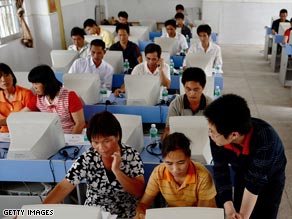
Farmers in China learn how to use the Internet in April 2008 in Guangdong province.

Farmers in China learn how to use the Internet in April 2008 in Guangdong province.

Rebecca MacKinnon, co-founder of Global Voices, an assistant professor of journalism at Hong Kong University, a former CNN correspondent and an observer of China and the Internet, recently discussed with CNN the move by Beijing.

CNN: Is this affecting Web sites in Hong Kong?

MacKinnon: Not to my knowledge. Of course, in Hong Kong there is a review on obscene articles ordinances and debate on how such content should be censored. There are some Web sites in mainland China that have Hong Kong investments that would be affected, but this is a one-country, two-systems policy. Hong Kong and China have separate legal jurisdictions.

CNN: Are these recent actions connected to filtering?

MacKinnon: This crackdown isn't related to filtering; there are two types of censorship already in place. One kind of censorship is blocking overseas Web sites. However, the crackdown on Monday, performed by six different government departments relates to a different type of censorship. This is aiming for Web sites that operate inside of China and the content is completely removed from the Internet." .

CNN: How effective will China's actions be?

MacKinnon: The crackdown listed 19 different Web sites. The government basically said there was too much inappropriate material, or "low and vulgar" content, and sites need to clean up their act.

Three Chinese Web sites apologized and created a hot line to report it. On Tuesday, three editors at Netease, based in South China, were dismissed as a result of content which appeared. Chinese Web site companies are definitely jumping to clean it.

oogle China apologized publicly on their Chinese blog about what they're doing in China and explained they're removing the inappropriate content. They even set up a hot line and support e-mail to allow users to report any inappropriate content. Netease, Baidu and Sina had also done the same thing and have all apologized. Companies are doing their best to comply.

However, people could argue that the technology they use to censor sexual content can also be used clean up political censorship however there is no direct evidence to show it.

CNN: How effective have other countries been with similar actions?

MacKinnon: A lot of countries are filtering Internet pornography on the Internet. Take a look at the Open Net Initiative (opennet.net), they show systematic studies on Internet filtering around the world. There are several dozen countries that filter the Internet on a national basis.

Australia is testing a nationwide filtering system. The United Kingdom temporarily blocked Wikipedia because it contained an image on an album cover of a child that appeared offensive.

However, the idea of censoring inappropriate content ties with debates on who has the power to decide what is appropriate and what is not. Internet censorship is happening all over the world and it's growing.

CNN: What do you think prompted this action by China?

MacKinnon: There are crackdowns from time to time. Generally, before Chinese New Year, there is some sort of anti-porn crackdown that takes place. It's a seasonal thing, not many people are entirely shocked. There was a crackdown on an online video site last March, which resulted in a 24-hour shutdown. Companies in China have expectations of these sorts of things and prepare to deal with it.

CNN: Is more content getting through China's filtering systems?

MacKinnon: Most Chinese users do not use proxies. However it is difficult to do a full-fledged survey to find out, since it is a very sensitive topic. Although you cannot get definitive numbers, analysts look at Chinese Internet behavior by observing Internet users and it appears that only small percentage uses proxies to circumvent certain blacklisted Web sites.  Learn more on how China filters the Internet »

And those users are usually foreigners trying to access their favorite blogs. However, there is so much interesting content that is not blocked and most people find it too much of a hassle to use proxies.


(original article)


Australian Federal Government’s Internet Censorship Plans

December 26, 2008 – (HOSTSEARCH.COM) – Concerns have been raised about the scope of possible Internet censorship planned by the Australian Federal government, a number of sources reported recently. While the plans were assumed to target Internet traffic, the country’s Broadband Minister, Stephen Conroy, recently suggested on an official blog that the government was setting up a trial of technology that “filters” information sent “between computers”. 

Discussing a move that appears to target issues related to peer-to-peer video and music file sharing over the Internet, Senator Conroy was reported as suggesting, "Technology that filters peer-to-peer and BitTorrent traffic does exist and it is anticipated that the effectiveness of this will be tested in the live pilot trial". 

The comments are found on a 
government blog in a discussion entitled “Digital Economy Future Directions”. The blog was established to gather public input on the direction Australia should take as far as the “digital economy” is concerned. To date the blog has received numerous comments attacking the government’s filtering plans. According to some reports, live trials of the filtering technology Senator Conroy was discussing are currently taking place, but Internet Service Providers have been given little information about its application.

(original article)

"Great Aussie Firewall" Causes Internet Censorship Outrage in Australia


The Australian government has come underfire after it announced it will be building a "Great Aussie Firewall", banning some 1,300 web sites from being viewed in Australia. Most of the sites will be child porn, but the list is arbitary.

This means the Australian government does not have to reveal it, nor does it face legal scrutiny. There have been protest held in some of Australia's major cities, and critics of the plan say it won't stop child porn.

According to Electronic Frontiers Australia, "A filter of this nature only blocks material on public Web sites. But illicit material ... is traded on the black market, through secret channels."

(original article)