Showing posts with label Oil. Show all posts

Tuesday, December 29, 2009

Yes, Yemen Has Oil

Washington’s Blog
Tuesday, Dec 29th, 2009

Yes, Yemen has oil.

The Middle Eastern nation – in the south of the Arabian Peninsula, bordering the Arabian Sea, Gulf of Aden, and Red Sea – has been exporting a couple of billion dollars worth of crude oil per year.

But it’s oil supplies are shrinking rapidly, and may be totally depleted within 10 years.

As the Yemen Observer notes:

Yemeni crude oil exports decreased to $1.5 billion during the fiscal period from January -October of 2009, compared with $4.2 billion during the same period of 2008, a decrease of $2.7 billion, the Central Bank of Yemen reported.

And the World Tribune points out:

The Carnegie Endowment for International Peace said Yemen was rapidly losing its crude oil reserves.

In a report, Carnegie said Yemeni oil exports, a key source of foreign currency, declined from 450,000 barrels per day in 2003 to 280,000 in early 2009, Middle East Newsline reported.

“Barring any major new discoveries, energy experts generously estimate that Yemen’s oil exports will cease in 10 years,” the report, titled “Yemen: Avoiding a Downward Spiral,” said.

Monday, April 27, 2009

Oil falls on worries swine flu may halt economic recovery

By Polya Lesova & Moming Zhou, MarketWatch
Last update: 2:32 p.m. EDT April 27, 2009

NEW YORK (MarketWatch) -- Oil futures fell more than 4% Monday, as the outbreak of a deadly swine flu raised concerns over the prospects for a global economic recovery.
Crude oil for June delivery dropped $2.30, or 4.5%, to $49.25 a barrel on the New York Mercantile Exchange. Earlier, the contract slumped nearly 7% to hit an intraday low of $48.01 a barrel.
"Fear is dominating the cyclical commodity markets today, as investors are concerned that the spreading of swine flu in Mexico may severely damp hopes of an economic recovery," said analysts led by Eugen Weinberg at Commerzbank in a note to clients.
However, "we consider these concerns premature and expect the oil price to move sideways, with some volatility between $45 and $55," they said. "Given that oil market fundamentals are still weak, downside risks prevail at the moment."
On Wall Street, stocks moved lower. The Dow Jones Industrial Average ($INDU:8,026.19-50.10-0.6%was down 0.9% to 8,006. It earlier fell to 7,987 amid concerns over the outbreak of swine flu, which originated in Mexico.
The disease has killed 103 people in Mexico and virtually shut down Mexico City on Sunday, while the U.S. declared a public health emergency. See full story.
"Nervousness about another batch of U.S. earnings reports and macro reports, coupled with a potential pandemic out of Mexico, are weighing on [oil] prices," said Edward Meir, an analyst at MF Global, in a note to clients.
"The Mexican situation is resurrecting fears of the chilling impact that the SARS epidemic had on economic growth," Meir said.
Investors sought refuge in currencies, which helped the U.S. dollar and Japanese yen.
The dollar index (DXY:85.77+1.05+1.2%, a measure of the greenback against a trade-weighted basket of currencies, stood at 85.235, up from 84.772 in North American dealings late Friday but off highs seen earlier Monday. See Currencies.
Front-month crude contracts ended last week's trading up 2.4%, despite another report that showed excessive buildup in U.S. crude inventories.
The Energy Information Administration reported that U.S. crude inventories increased 3.7 million barrels to 370.6 million barrels in the week ended April 17, the highest level since September 1990.
Also in energy trading, May reformulated gasoline fell 5.13 cents, or 3.5%, to $1.3962 a gallon and May heating oil dropped 5.05 cents, or 3.7%, to $1.3178 a gallon.
May natural-gas futures fell 8.5 cents, or 2.6%, to $3.212 per million British thermal units. End of Story
Polya Lesova is a New York-based reporter for MarketWatch.
Moming Zhou is a MarketWatch reporter based in New York.

Monday, April 6, 2009

Hawaiians May Need Special ID to Buy Gas in 2010

Kurt Nimmo
Infowars
April 3, 2009

In a move completely ignored by the corporate media, the state of Hawaii has introduced  resolutions in the Senate and House to initiate a study by the Insurance Commissioner to determine how best to deny gasoline purchases to uninsured motorists.

featured stories   Hawaiians May Need Special ID to Buy Gas in 2010
gas
Hawaiian government wants motorists to use a special ID card in order to buy gasoline.

In order to do this, the Hawaii Senate and House concur that “motor vehicle insurance companies issue motor vehicle insurance cards to insured drivers and to require that the card be either scanned electronically or examined by the sellers of gasoline in order to purchase gasoline.”

If these bills pass in the regular 2010 session, residents will not only need the state’s permission to buy gasoline but will in essence need permission to work and buy food, that is unless they walk or ride bicycles to work or the grocery store.

Since the September 11, 2001, false flag attacks, the federal government has worked overtime to impose national ID schemes on the American people. The September 11 whitewash commission recommended “national standards” for “identification documents,” including driver’s licenses in 2004.

“There needs to be consistent standards to ensure the integrity of both the document and the issuance process,” said commission member Jamie S. Gorelick, a former Clinton administration Justice Department official who is a member of the CFR and linked to numerous globalist foundations and the CIA (see this Muckety relationship map).

Christopher B. Cannon, Utah Republican, told the commission the government needs to “take something that everyone accepts now and have it standardized in a way that it really identifies the people who are holding onto it.” Skeptical lawmakers characterized this as a stealth national ID plan brought in “through the back door.”

“I’ve always been concerned about a universal ID card or system, somewhat like in Nazi Germany,”Rep. Barry Goldwater Jr. said at the time. “That’s scary. We value our privacy and freedom and are very concerned about the power of the U.S. government.

Hawaii’s proposal is obviously not a national or state ID scheme. It is, however, yet another way to get the proles to accept the idea that they need to be carded for essentials in order to fight against deadbeats who do not buy state mandated insurance.

Tuesday, January 13, 2009

War and Natural Gas: The Israeli Invasion and Gaza's Offshore Gas Fields


Global Research, January 8, 2009

The military invasion of the Gaza Strip by Israeli Forces bears a direct relation to the control and ownership of strategic offshore gas reserves. 

This is a war of conquest. Discovered in 2000, there are extensive gas reserves off the Gaza coastline. 

British Gas (BG Group) and its partner, the Athens based Consolidated Contractors International Company (CCC) owned by Lebanon's Sabbagh and Koury families, were granted oil and gas exploration rights in a 25 year agreement signed in November 1999 with the Palestinian Authority. 

The rights to the offshore gas field are respectively British Gas (60 percent); Consolidated Contractors (CCC) (30 percent); and the Investment Fund of the Palestinian Authority (10 percent). (Haaretz, October 21,  2007). 

The PA-BG-CCC agreement includes field development and the construction of a gas pipeline.(Middle East Economic Digest, Jan 5, 2001). 

The BG licence covers the entire Gazan offshore marine area, which is contiguous to several Israeli offshore gas facilities. (See Map below). It should be noted that 60 percent of the gas reserves along the Gaza-Israel coastline belong to Palestine.  

The BG Group drilled two wells in 2000: Gaza Marine-1 and Gaza Marine-2. Reserves are estimated by British Gas to be of the order of 1.4 trillion cubic feet, valued at approximately 4 billion dollars. These are the figures made public by British Gas. The size of Palestine's gas reserves could be much larger. 
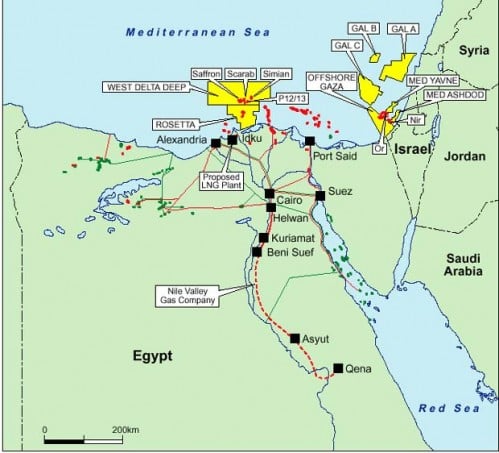

Map 1
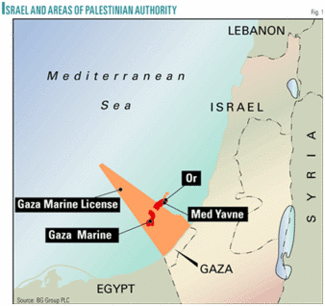
Map 2

Who Owns the Gas Fields

The issue of sovereignty over Gaza's gas fields is crucial. From a legal standpoint, the gas reserves belong to Palestine. 

The death of Yasser Arafat, the election of the Hamas government and the ruin of the Palestinian Authority have enabled Israel to establish de facto control over Gaza's offshore gas reserves. 

British Gas (BG Group) has been dealing with the Tel Aviv government. In turn, the Hamas government has been bypassed in regards to exploration and development rights over the gas fields. 

The election of Prime Minister Ariel Sharon in 2001 was a major turning point. Palestine's sovereignty over the offshore gas fields was challenged in the Israeli Supreme Court. Sharon stated unequivocally that "Israel would never buy gas from Palestine" intimating that Gaza's offshore gas reserves belong to Israel. 

In 2003, Ariel Sharon, vetoed an initial deal, which would allow British Gas to supply Israel with natural gas from Gaza's offshore wells. (The Independent, August 19, 2003) 

The election victory of Hamas in 2006 was conducive to the demise of the Palestinian Authority, which became confined to the West Bank, under the proxy regime of Mahmoud Abbas.  

In 2006, British Gas "was close to signing a deal to pump the gas to Egypt." (Times, May, 23, 2007). According to reports, British Prime Minister Tony Blair intervened on behalf of Israel with a view to shunting the agreement with Egypt. 

The following year, in May 2007, the Israeli Cabinet approved a proposal by Prime Minister Ehud Olmert  "to buy gas from the Palestinian Authority." The proposed contract was for $4 billion, with profits of the order of $2 billion of which one billion was to go the Palestinians. 

Tel Aviv, however, had no intention on sharing the revenues with Palestine. An Israeli team of negotiators was set up by the Israeli Cabinet to thrash out a deal with the BG Group, bypassing both the Hamas government and the Palestinian Authority:   

"Israeli defence authorities want the Palestinians to be paid in goods and services and insist that no money go to the Hamas-controlled Government." (Ibid, emphasis added)

The objective was essentially to nullify the contract signed in 1999 between the BG Group and the Palestinian Authority under Yasser Arafat. 

Under the proposed 2007 agreement with BG, Palestinian gas from Gaza's offshore wells was to be channeled by an undersea pipeline to the Israeli seaport of Ashkelon, thereby transferring control over the sale of the natural gas to Israel. 

The deal fell through. The negotiations were suspended:

 "Mossad Chief Meir Dagan opposed the transaction on security grounds, that the proceeds would fund terror". (Member of Knesset Gilad Erdan, Address to the Knesset on "The Intention of Deputy Prime Minister Ehud Olmert to Purchase Gas from the Palestinians When Payment Will Serve Hamas," March 1, 2006, quoted in Lt. Gen. (ret.) Moshe Yaalon, Does the Prospective Purchase of British Gas from Gaza's Coastal Waters Threaten Israel's National Security?  Jerusalem Center for Public Affairs, October 2007)

Israel's intent was to foreclose the possibility that royalties be paid to the Palestinians. In December 2007, The BG Group withdrew from the negotiations with Israel and in January 2008 they closed their office in Israel.(BG website). 

Invasion Plan on The Drawing Board

The invasion plan of the Gaza Strip under "Operation Cast Lead" was set in motion in June 2008, according to Israeli military sources: 

"Sources in the defense establishment said Defense Minister Ehud Barak instructed the Israel Defense Forces to prepare for the operation over six months ago [June or before June] , even as Israel was beginning to negotiate a ceasefire agreement with Hamas."(Barak Ravid, Operation "Cast Lead": Israeli Air Force strike followed months of planning, Haaretz, December 27, 2008)

That very same month, the Israeli authorities contacted British Gas, with a view to resuming crucial negotiations pertaining to the purchase of Gaza's natural gas:  

"Both Ministry of Finance director general Yarom Ariav and Ministry of National Infrastructures director general Hezi Kugler agreed to inform BG of Israel's wish to renew the talks.

The sources added that BG has not yet officially responded to Israel's request, but that company executives would probably come to Israel in a few weeks to hold talks with government officials." (Globes online- Israel's Business Arena, June 23, 2008)

The decision to speed up negotiations with British Gas (BG Group) coincided, chronologically, with the planning of the invasion of Gaza initiated in June. It would appear that Israel was anxious to reach an agreement with the BG Group prior to the invasion, which was already in an advanced planning stage.  

Moreover, these negotiations with British Gas were conducted by the Ehud Olmert government with the knowledge that a military invasion was on the drawing board. In all likelihood, a new "post war" political-territorial arrangement for the Gaza strip was also being contemplated by the Israeli government.     

In fact, negotiations between British Gas and Israeli officials were ongoing in October 2008, 2-3 months prior to the commencement of the bombings on December 27th.  

In November 2008, the Israeli Ministry of Finance and the Ministry of National Infrastructures instructed Israel Electric Corporation (IEC) to enter into negotiations with British Gas, on the purchase of natural gas from the BG's offshore concession in Gaza. (Globes, November 13, 2008) 

"Ministry of Finance director general Yarom Ariav and Ministry of National Infrastructures director general Hezi Kugler wrote to IEC CEO Amos Lasker recently, informing him of the government's decision to allow negotiations to go forward, in line with the framework proposal it approved earlier this year.

The IEC board, headed by chairman Moti Friedman, approved the principles of the framework proposal a few weeks ago. The talks with BG Group will begin once the board approves the exemption from a tender." (Globes Nov. 13, 2008) 

Gaza and Energy Geopolitics 

The military occupation of Gaza is intent upon transferring the sovereignty of the gas fields to Israel in violation of international law.

What can we expect in the wake of the invasion? 

What is the intent of Israel with regard to Palestine's Natural Gas reserves? 

A new territorial arrangement, with the stationing of Israeli and/or "peacekeeping" troops?  

The militarization of the entire Gaza coastline, which is strategic for Israel? 

The outright confiscation of Palestinian gas fields and the unilateral declaration of Israeli sovereignty over Gaza's maritime areas?  

If this were to occur, the Gaza gas fields would be integrated into Israel's offshore installations, which are contiguous to those of the Gaza Strip. (See Map 1 above). 

These various offshore installations are also linked up to Israel's energy transport corridor, extending from the port of Eilat, which is an oil pipeline terminal, on the Red Sea to the seaport - pipeline terminal at Ashkelon, and northwards to Haifa, and eventually linking up through a proposed Israeli-Turkish pipeline with the Turkish port of Ceyhan. 

Ceyhan is the terminal of the Baku, Tblisi Ceyhan Trans Caspian pipeline. "What is envisaged is to link the BTC pipeline to the Trans-Israel Eilat-Ashkelon pipeline, also known as Israel's Tipline." (See Michel Chossudovsky, The War on Lebanon and the Battle for Oil, Global Research, July 23, 2006)
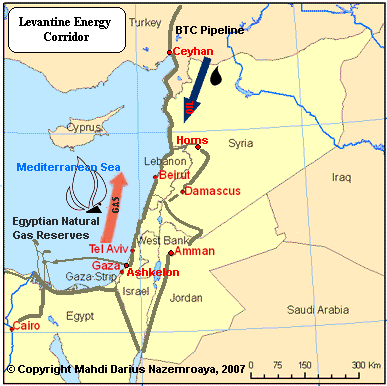


Map 3
 

Saturday, December 13, 2008

Gulf Oil CEO: $1 a gallon gas in 2009

Stephen C. Webster
Published: Thursday December 4, 2008

CEO also claims carbon-driven warming a 'myth' as Merrill Lynch predicts $25 a barrel oil

 
Joe Petrowski, CEO of Massachusetts-based Gulf Oil, has some good news for consumers.

In years past, market speculation inflated prices, said Petrowski. Now that the prices are deflated, speculators may 'overshoot' and actually drive the consumer cost down further.

His statements came shortly before Merrill Lynch & Co. predicted oil prices will 
plunge to $25 a barrel in the coming year if the global recession begins heavily affecting China. 

Petrowski also claimed that the threat of global warming driven by carbon emissions is a 'myth,' and instead insisted that dependence on oil imports poses a greater threat to economic stability. 

Petrowski's remarks were delivered to the South Shore Chamber of Commerce in Randolph, MA, according to a 
published report.

In spite of his remarks, the Intergovernmental Panel on Climate Change, in its 2005 report on the effect of hydroflorocarbons on Earth's atmosphere,
maintained (PDF link) that "the balance of evidence suggests a discernible human influence of the global climate."

AAA's 
national average gas price for regular unleaded was $1.78 as of Thursday, down from $3.04 this time last year. The highest recorded national average was $4.11, registered July 17, 2007.

Oil was trading at $44 a barrel on Thursday evening.

Sunday, October 19, 2008

This is what we call a CLUE!


Check this site and research the people involved, you will have a field trip.

Saturday, October 18, 2008

Black Gold Down

By Daniel Politi
Posted Friday, Oct. 17, 2008, at 6:26 AM ET


The Los Angeles Times and New York Times lead with, while theWall Street Journal fronts, the continuing downward spiral of oil prices, which dropped below $70 a barrel for the first time in 14 months. Some predict oil could fall to as low as $50 a barrel before the end of the year, although that seems unlikely, considering that OPEC has called for an emergency meeting next week.

If they bring new-found Oil on to the market now, like Lindsay Williams has revealed might happen, we most likely will see a full collapse of the Dollar, breaking down OPEC in it's fall.

Wednesday, October 15, 2008

$50 a barrel?

Lindsey Williams describes that there are huge oil fields in Indonesia, and Northern Russia that his 'inside source' claims will be tapped in order to drop oil prices drastically. Lindsey also discusses the U.S. plan to "decimate the Middle East" which will eventually lead the U.S. into a major Economic Crash. (As if we didn't already see it coming.)

-mcNasty comment: In the beginning when I heard this interview, I was very skeptical about the information being put forward. I suspected that Lindsay was being used to spread disinformation, but still there was something very real about it: the death threats!
Now Oil is down below $90 a barrel (most probably to create the illusion of better times) so I have decided to present this information in case it actually becomes true. (the signs are starting to appear)
Let me put it this way: let's put the information to the test and see if this is a good source.
Now it's documented here, and you can then go back and check the facts a year from now.

Listen to Linday Williams on the Alex Jones Show:

Part 1: