Showing posts with label Water. Show all posts

Saturday, August 8, 2009

EU Hands Over Water to Corporations

Reuters
August 7, 2009

French water distribution firm Lyonnaise des Eaux, a unit of GDF Suez (GSZ.PA) won permission from the European Commission on Wednesday to acquire six firms active in water collection, treatment and supply in France.

Lyonnaise des Eaux (LDE) is to buy shares held by Veolia Eau-Compagnie Générale des Eaux (Veolia Eau) in six subsidiaries owned jointly with Veolia Eau (VIE.PA).

The executive arm of the 27-nation European Union said in a statement that its investigation had revealed the proposed deal would not harm competition in the markets concerned.

Read entire article

Tuesday, March 3, 2009

Fluoride Will Be Added To City Tap Water

5:51pm UK, Thursday February 26, 2009

Thomas Moore, health correspondent

Health chiefs have agreed the controversial move of adding fluoride to the water supply of 195,000 people in Southampton and and South Hampshire.

Tap water

Five million Brits have drunk water with added fluoride for several decades

Southampton Primary Care Trust argues it is the only way to reduce tooth decay in children across the city.

But campaigners fear fluoride could have health risks, saying adding it to tap water amounts to mass medication.

Five million people in England and Wales have been drinking water with added fluoride for several decades.

But other water companies refused to add the chemical until its safety had been resolved.

Now the Department of Health is putting pressure on the NHS to use powers under the Water Act 2003 to demand water companies add the chemical.

Dentist

Dentist Ragini Ramchandani

In Southampton, four in every 10 children have a filling by the time they start school.

Dentist Ragini Ramchandani says some parents fail to brush their children's teeth properly. Not even giving out free toothpaste has helped.

She said: "Dental health has improved in Southampton over the last 40 years. A lot of that is due to fluoridated toothpaste.

"But what has not improved is the inequalities between people with good and poor dental health. That gap has not closed at all."

But independent experts at York University have concluded there is only limited evidence that adding fluoride to water reduces decay.

Nobody knows what it can do. So I say err on the side of caution and don't put it in the water.

Mother of two, Jo-Anne Carey

And it warns any benefit comes at the cost of increasing the number of children developing mottled teeth from consuming too much fluoride.

The uncertain scientific evidence has led to an angry debate between those for and against fluoride.

Jo-Anne Carey ensures her two children brush their teeth properly twice a day with a fluoride toothpaste.

She doesn't want an additional - and unregulated - dose in the tap water.

"What is this toxin going to do in the body for the next 40 years? It's cumulative. It sits in the tissue and grows.

"Nobody knows what it can do. So I say err on the side of caution and don't put it in the water."

The decision on whether to give Southampton Primary Care Trust was taken by the regional health authority.

Water pump

Water companies are under pressure

Campaigners claim the public consultation has been a sham and that NHS South Central bowed to pressure from the Department of Health.

But chief executive Jim Easton insists the decision was taken based on the evidence.

"Let me be very clear. We have received no direct or indirect pressure from the Department of Health, ministers or senior officials to make a decision one way or the other."

(original article)

Friday, January 30, 2009

Super-Potent Drugs In India's Water

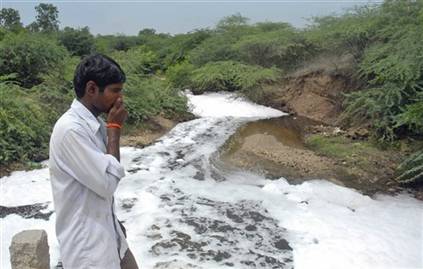
Medical researchers have found that some of the streams, rivers, and groundwater in Patancheru, India, are really "a soup of 21 different active pharmaceutical ingredients, used in generics for treatment of hypertension, heart disease, chronic liver ailments, depression, gonorrhea, ulcers and other ailments. Half of the drugs measured at the highest levels of pharmaceuticals ever detected in the environment." 

[Image: The Iska Vagu stream near Hyderabad, India. "Indian factories that make lifesaving drugs swallowed by millions worldwide are creating the worst pharmaceutical pollution ever measured,"we read, "spewing enough of one antibiotic into a stream each day to treat everyone living in Sweden for a work week." Photo by AP Photo/Mahesh Kumar A].

"If you just swallow a few gasps of water," a German doctor said to MSNBC, "you're treated for everything. The question is for how long?"
Indeed, all of this has the unsurprising effect that "some of India's poor are unwittingly consuming an array of chemicals that may be harmful, and could lead to the proliferation of drug-resistant bacteria." For instance, amongst this mix are high levels of Ciproflaxin:
    The more bacteria is exposed to a drug, the more likely that bacteria will mutate in a way that renders the drug ineffective. Such resistant bacteria can then possibly infect others who spread the bugs as they travel. Ciprofloxacin was once considered a powerful antibiotic of last resort, used to treat especially tenacious infections. But in recent years many bacteria have developed resistance to the drug, leaving it significantly less effective.
With sources of freshwater all over the world now showing at least trace signs of pharmaceutical pollution, is some kind of global superbug brewing? 
Aside from the very real health implications of this story, though, I'm fascinated by these drugs' effect on the landscape; in other words, millions of pounds' worth of loose pharmaceuticals will surely someday form a detectable layer in the soil, given time. 
Pharmaco-geological formations take shape in the sand, compacted into strange new types of stone. The locals dissolve slices of it in their tea, as it's used to treat illnesses. 
Thousands of years pass; then millions. The rocks you're looking at in the wall of that canyon are made of lithified Prozac. Tylenol Gorge State Park. 
A deltaic geography of sedimentary Tamiflu is eventually mined as a building material; temples of this unusually smooth rock are built; visits to them are believed to help prevent infection. 
And how will this affect plants? If river grasses and trees begin to accumulate this novel class of mineral, taking pharmaceutical-rich waters up into their roots, will it change the way they grow? Day of the Triffids.
"We don't have any other source, so we're drinking it," a local woman named R. Durgamma explains to MSNBC. In a particularly chilling detail that reveals how those in power clearly know what is happening there, she adds: "When the local leaders come, we offer them water and they won't take it."