Showing posts with label Riot. Show all posts

Monday, May 11, 2009

G20 Police ‘Used Undercover Men to Incite Crowds’

May 11th, 2009

Via: Guardian:

An MP who was involved in last month’s G20 protests in London is to call for an investigation into whether the police used agents provocateurs to incite the crowds.

Liberal Democrat Tom Brake says he saw what he believed to be two plain-clothes police officers go through a police cordon after presenting their ID cards.

Brake, who along with hundreds of others was corralled behind police lines near Bank tube station in the City of London on the day of the protests, says he was informed by people in the crowd that the men had been seen to throw bottles at the police and had encouraged others to do the same shortly before they passed through the cordon.

Brake, a member of the influential home affairs select committee, will raise the allegations when he gives evidence before parliament’s joint committee on human rights on Tuesday.

“When I was in the middle of the crowd, two people came over to me and said, ‘There are people over there who we believe are policemen and who have been encouraging the crowd to throw things at the police,’” Brake said. But when the crowd became suspicious of the men and accused them of being police officers, the pair approached the police line and passed through after showing some form of identification.

Brake has produced a draft report of his experiences for the human rights committee, having received written statements from people in the crowd. These include Tony Amos, a photographer who was standing with protesters in the Royal Exchange between 5pm and 6pm. “He [one of the alleged officers] was egging protesters on. It was very noticeable,” Amos said. “Then suddenly a protester seemed to identify him as a policeman and turned on him. He ­legged it towards the police line, flashed some ID and they just let him through, no questions asked.”

Amos added: “He was pretty much inciting the crowd. He could not be called an observer. I don’t believe in conspiracy theories but this really struck me. Hopefully, a review of video evidence will clear this up.”

Friday, May 1, 2009

Outside the Box: Update on Martial Law Preparations -Februrary 26, 2009

The Government seems to have a interesting habit of picking small towns to host Anti-terror drills that involve US Troops patrolling US Streets. The alarming number of drills indicate that the government is accelerating their efforts to er prepared as they can to deal with an angry American population.


Saturday, April 25, 2009

Police Caught On Tape Trying to Recruit Protester

Paul Lewis 
The Guardian
April 25, 2009

Undercover police are running a network of hundreds of informants inside protest organisations who secretly feed them intelligence in return for cash, according to evidence handed to the Guardian.

They claim to have infiltrated a number of environmental groups and said they are receiving information about leaders, tactics and plans of future demonstrations.

The dramatic disclosures are revealed in almost three hours of secretly recorded discussions between covert officers claiming to be from Strathclyde police, and an activist from the protest group Plane Stupid, whom the officers attempted to recruit as a paid spy after she had been released on bail following a demonstration at Aberdeen airport last month.

Matilda Gifford, 24, said she recorded the meetings in an attempt to expose how police seek to disrupt the legitimate activities of climate change activists. She met the officers twice; they said they were a detective constable and his assistant. During the taped discussions, the officers:

Read entire article

Monday, April 6, 2009

Black Bloc Provocateurs Set Strasbourg Hotel on Fire

Infowars
April 4, 2009

“Protesters demonstrating against a NATO summit in Strasbourg set fire to a hotel in the city near the river Rhine on Saturday, AFP journalists witnessed.”

Described as “hardline,” the Black Bloc provocateurs, “armed with metal bars,” also wrecked a wrecked a chapel, a pharmacy, an empty police post and other buildings at the French end of the Europe bridge connecting Strasbourg with Germany, according to AFP.

In order to demonize the anti-NATO protests as the work of violent “anarchists” (agents provocateurs), the New York Times described participants as “a mix of anti-globalization and anti-military activists (who) set a hotel and border post on fire, while riot police used tear gas to keep them back.”

Sky News (owned by Rupert Murdoch) reports: “Some of the protesters — throwing rocks — tried to storm a massive police blockade at the Pont d’Anvers bridge, and were driven back by water cannon, tear gas, flash bombs and rubber bullets.”

The BBC filed a video report highlighting the staged violence.

Police used the staged violence as an excuse to arrest demonstrators. “Police later detained dozens of demonstrators, lying them face down on the ground before hauling them away,” Sky News reports elsewhere. “Journalists were stopped by police from approaching the campsite area… The campsite had been set up to house demonstrators during the two-day talks.”

As noted in the video here, the legitimate anti-NATO protesters are determined to use non-violent civil disobedience to block the summit. In order to provide an excuse to use batons and rubber bullets against them, agents provocateurs masquerading as Black Bloc anarchists have been dispatched with instructions to burn down hotels and vandalize churches.

Earlier in the week, “anarchist” agents provocateurs were dispatched during the G20 with orders to smashed up the Royal Bank of Scotland. The corporate media used images of this vandalism to demonize non-violent demonstrators.

“The British authorities seemed to have little problem with allowing a group of violent black bloc anarchists to smash up the RBS building while provoking police yesterday, despite the group announcing their target in advance, yet a legitimate anti-poverty organization has had its ‘accreditation’ to protest at the G20 removed on the orders of Downing Street,” wrote Paul Joseph Watson on April 2. The authorities “knew that the building was a prime target, and yet it was the only one in the street not boarded up. A cafe across the street was boarded up and yet the RBS building was left completely vulnerable to attack.”

Tuesday, March 31, 2009

Anarchists Plot Mayhem for the G20 in London

Kurt Nimmo
Infowars
March 30, 2009

According to the Independent, “extremist and anarchist groups” are handing out literature ahead of London’s G20 summit instructing demonstrators on how best to confront and attack the police.

The online pamphlets suggest certain groups are advising their followers on how to beat the police should things turn rough. One document, called “Guide to Public Order Situations”, explains how to breach lines of riot police using a “snow plough” human formation; throw rape alarms to make it hard for the police to give orders; resist baton and horse charges using nets; and “de-arrest” seized protesters.

featured stories   Anarchists Plot Mayhem for the G20 in London
Geithner
Anarchists plan to attack police in London and thus discredit legitimate protests aimed at the global bankers and their engineered economic crisis.

“We want to see resistance on the street on Wednesday. If the police are ready for you, go and fight them. If they’re not, give them a surprise,” a supposed anarchist told marchers at Hyde Park.

“G20 protesters are circulating detailed pamphlets advising people on how to win street battles against riot police and what to do if arrested,” write Jerome Taylor and Kunal Dutta, “The vast majority of protests are likely to be peaceful but the Metropolitan Police claims extremist and anarchist groups might resort to violence.”

In other words, “extremist and anarchist” violence will be used by police as an excuse to attack non-violent demonstrators.

MP George Galloway accused the London Metropolitan Police of engaging in “a deliberate conspiracy to bring about scenes of violent disorder” during Bush’s visit in June of 2006. In a letter to the Home Secretary, Galloway detailed incitements that an officer made towards police and how the man encouraged other protesters to charge baton-wielding officers and hurl projectiles at them. “Several protesters were kept in custody and were later charged with offenses including affray, violent disorder, assaulting police and possession of an offensive weapon,” Steve Watson wrote at the time.

Police instigated “anarchist” violence is a favored tactic of governments around the world. In December of 2008, a Greek television show revealed how Greek police posed as anarchists and destroyed property.

In 2007, agents provocateurs attempted to incite violence in Montebello, Canada, during a peaceful protest against a Prosperity Partnership summit. A video and photographs later revealed the so-called anarchists were wearing the same military boots as the police.

Other documented instances of agents provocateurs used against peaceful protests occurred in Seattle in 1999 at the World Trade Organization meeting, at the WTO protests in Genoa, Italy, and during protests in Miami in late November 2003.

featured stories   Anarchists Plot Mayhem for the G20 in London
Italian policefeatured stories   Anarchists Plot Mayhem for the G20 in London
Italian police “beat the shit” out of protesers as suggested by former Italian President Francesco Cossiga.

Last year, former Italian President Francesco Cossiga said the Italian government should deal with widespread demonstrations by students and teachers over a cut in state funding of education by “beat the shit out of the protesters.” Cossiga is one of the founders of the Operation GLADIO covert intelligence unit. GLADIO has a long and sordid history of blowing up train stations and engaging in random murder and blaming the violence on leftist political groups.

The reason for this staged violence “was quite simple,” explained GLADIO agent Vincezo Vinciguerra in sworn court testimony. “They were supposed to force these people, the Italian public, to turn to the state to ask for greater security. This is the political logic that lies behind all the massacres and the bombings which remain unpunished, because the state cannot convict itself or declare itself responsible for what happened.”

In likewise fashion the G20 — shorthand for the finance ministers and central bank governors of the leading 20 world economies — may need to portray overwhelmingly peaceful protesters opposed to the policies of IMF, World Bank, the European Central bank and other bankster dominated criminal organizations as violent terrorists.

In order to fill London’s streets with police and impose a state of “heightened security,” British authorities on Monday said they questioned five people suspected of possessing bomb-making equipment, according to the UPI. “Officers, acting under the Terrorism Act, said their raids turned up real weapons, fake weapons and materials espousing ‘political ideology’ during a house search, the Daily Mail said.”

“Britain already is at a ’severe’ level of alert, meaning security officials believe an attack is highly likely. Bankers are being warned to dress casually — to deflect populist anger aimed their way — and luxury hotels are securing their perimeters for fear they could be targeted,” reports the Associated Press.

Michael Clarke, the head of London’s Royal United Services Institute think-tank, said small terrorist groups may use the cover of planned protests by environmentalists, anti-war protesters and labor unions to mount an attack… Following November’s seaborne attack on Mumbai, India’s financial center, extra patrol boats will guard the steel gray waters of the River Thames, and police frogmen will scour the river’s length for floating bombs.

In December, former Pakistani ISI chief Hamid Gul told Alex Jones he believes the Mumbai attacks were an inside job along the lines of the 9/11 inside job. “Gul joins a raft of former government officials and intelligence heads in questioning 9/11, the most recent of which was former Italian President Francesco Cossiga, who last December said that the attacks were carried out by elements of the CIA and Mossad,” writes Paul Joseph Watson.

Cossiga should know. As noted above, he is one of the founders of the GLADIO terrorist group.


Saturday, March 14, 2009

Civil Unrest in America?

by José Miguel Alonso Trabanco
Global Research, March 9, 2009


Eurasia is currently experiencing serious problems derived from financial and economic difficulties such as unemployment, GDP negative growth, currency depreciation, overall economic slowdown and so on. Several members of both the European Union and NATO (Poland, Hungary, Iceland come to mind) are already dealing with a considerable deal of domestic discontent. Some States from the Former Soviet Union (notably Ukraine, Belarus and the Central Asian Republics) and even Russia itself are facing similar problems. Even Chinese government officials acknowledge protests in the Chinese mainland, as pointed out by Professor Michael Klare, which means that East Asia is by no means an exception. As we shall see, financial and economic conditions are equally grave in the American hemisphere, if not more so.Zbigniew Brzezinski, former National Security Advisor and early supporter of Barack Obama's presidential campaign, has warned that civil unrest on American soil is a possibility that should not be dismissed. Brzezinski explains that "[the United States is] going to have millions and millions of unemployed, people really facing dire straits. And we’re going to be having that for some period of time before things hopefully improve. And at the same time there is public awareness of this extraordinary wealth that was transferred to a few individuals at levels without historical precedent in America..." Brzezinski concludes with this noteworthy remark "...hell, there could be even riots".The aforementioned means that the upper echelons of the American political elite have realized that the current financial and economic turmoil is much worse than what many experts had foreseen, and that things could really spiral out of control if the present situation deteriorates even further. Indeed, optimistic signs are nowhere to be found. Quite the contrary.The full magnitude of the financial tsunami is clearly reflected in a piece written by Barry Ritholtz, who states that the bailout plan promoted by former US Secretary of the Treasury Henry "Hank" Paulson amounts to a sum of money that is superior to the Louisiana Purchase, the New Deal, the Marshall Plan, the Apollo Lunar Project, the Korean War, the Vietnam War, the invasion of Iraq and other large government expenditures - combined (!). This illustrates that America's top policymakers (both Democratic and Republican) hold serious concerns about the health of the American financial system and the American economy.  Lehman Brothers' bankruptcy (the largest in American history) was merely the tip of the iceberg and economic and financial conditions have dramatically worsened ever since. On January 22 2009, the Christian Science Monitor published that the four largest U.S. banks "have lost half of their value since January 2." Moreover, in the period from summer 2008 to March 2009, the Dow Jones Industrial Average index has decreased more than 50%. Furthermore, during February 2009 alone, more than 651 000 jobs were lost in the US, whose unemployment rate has now reached 8.1 %, the highest in 26 years. Also, some US car manufacturers (such as Ford, General Motors and Chrysler), once the pride of America's industry, are practically on life support.Steve Lohr, from the New York Times, writes that "Some of the large banks in the United States, according to economists and other finance experts, are like dead men walking." Indeed, there were only two investment banks left: Morgan Stanley and Goldman Sachs and their condition is not exactly solid because they have managed to survive by becoming ordinary commercial banks. The Guardian reproduces an assessment by Bill Isaac, an experienced financial expert; he claims that the transformation of both Morgan Stanley and Goldman Sachs is "a shame because this country [the US] was built, in part, on risk-taking by Goldman and Morgan and by a whole bunch of firms before them." Karl West, from the Daily Mail mentions that financial specialists warn that mammoth bank Citigroup "could collapse".All of the above indicates that the much-feared financial meltdown is no longer a distant and remote possibility because in fact it is already taking place. However, this chaos might trigger some very serious and preoccupying consequences. In order to have a clear understanding of these implications, it is vital to take into account some reports that were not given the proper amount of attention they deserved when they were first published.Professor Michel Chossudovsky observed that the US Army 3rd Infantry's 1st Brigade Combat Team returned from Iraq some months ago. That information is extremely disturbing because such military unit "may be called upon to help with civil unrest and crowd control", according to official sources. Now, what scenario could possibly require the operational deployment of said units on American soil? Professor Chossudovsky puts forward an intriguing hypothesis that must be borne in mind. He argues that "Civil unrest resulting from from the financial meltdown is a distinct possibility, given the broad impacts of financial collapse on lifelong savings, pension funds, homeownership, etc". Shortly afterwards, the Centre for Research on Globalization website posted an article written by Wayne Madsen. Mr. Madsen claims that a highly confidential official report has been circulating among senior members of the US Congress and their top advisors. The report has been allegedly nicknamed as the "C & R document". The author stipulates that those letters stand for none other than "conflict" and "revolution" because those scenarios are supposedly regarded by America's policymakers as plausible consequences triggered by a financial meltdown. According to Mr. Madsen, the content of the document reveals that severe financial chaos could spark a major war if Washington refuses to honor its foreign debt and/or massive riots in  US cities if the American population does not accept a considerable tax increase.For decades, overall political stability in the US was taken for granted. However, as it has been pointed out, even senior American statesmen are taking into consideration that financial volatility could fuel a wave of discontent which could easily reach troubling proportions. It seems that America itself is not immune from "regime-threatening instability" as the Pentagon and the American intelligence community terms it. It is likely that American government officials have not dismissed the worst-case scenario. Indeed it looks like they have been preparing accordingly.Therefore, as has been scrutinized here, once one proceeds to connect the dots a very dark picture begins to emerge, to say the least. An all-encompassing cloud of uncertainty prevents us from formulating an accurate forecast regarding what developments will occur and how they will unfold during the next few months, let alone years. The only thing that can be taken for granted and that one can be sure of is that the unthinkable has now become thinkable.José Miguel Alonso Trabanco is an  independent writer based in Mexico specialising in geopoltical and military affairs. He has a degree in International Relations from the Monterrey Institute of Technology and Higher Studies, Mexico City. His focus is on contemporary and historic geopolitics, the world's balance of power, the international system's architecture and the emergence of new powers. 

Thursday, February 26, 2009

Urban Warfare Drills Linked To Coming Economic Rage

Paul Joseph Watson
Prison Planet.com
Monday, February 23, 2009

Urban warfare training drills are taking place across the country as top analysts as well as officials predict a potential “summer of rage” across Europe and America as civil unrest from the economic fallout builds.

Earlier this month, 150 U.S. troops from the U.S. Special Operations Command whizzed around the streets of New Orleans in military helicopters and even dropped bombs in what officials described as a “training event”.

An Iowa National Guard training exercise in Arcadia, Iowa, scheduled for April was originally billed as an “invasion” before public opposition caused the drill to be scaled back. The exercise included Guard troops patrolling streets, searching houses and confiscating firearms.

No less than 2,200 U.S. Marines were also involved in urban operations training in Richmond, VIrginia, throughout January, drills that involved landing troops in populated areas, allowing military pilots to “familiarize themselves with the area.”

Military choppers hovered precariously low over parking lots as citizens were acclimated to seeing active duty military assets engaged in law enforcement style activities.

Watch a clip filmed by a startled Richmond resident who wasn’t even aware that Marines were conducting drills due to scant forewarning on behalf of authorities and the media.

Are such drills really for the purpose of preparing troops for foreign combat zones? Undoubtedly - but other factors indicate that the drills may very well also be aimed at preparing troops for dealing with mass civil unrest as the economic crisis worsens.

There’s no question that U.S. authorities have been closely observing riots that have toppled governments in Iceland and Latvia and also threatened to do so in several other European countries. The fact that they have contingency plans in place to deal with such scenarios should they unfold in America cannot be disputed.

Indeed, before a media exposé forced them into a denial, Northcom revealed that one of the duties of at least 20,000 active duty troops that are being placed inside the United States would be dealing with “civil unrest and crowd control”.

Meanwhile, millions of dollars that were set aside as part of the so-called bailout have in fact been handed over to local police departments and spent on military tools like armored vehicles, unmanned aerial surveillance drones and high-powered firearms for SWAT teams.

In addition, with many predicting that Mexico is on the verge of collapse as a result of the economic crisis and the out of control drug war, Texas officials have already established contingency plans to deal with an influx of immigrants, a program that would only address “law enforcement concerns” and not humanitarian needs.

HR 645, otherwise known as the National Emergency Centers Establishment Act, would mandate the expansion of FEMA detention camps which would likely to be used to detain illegal immigrants as well as rioting American citizens.

The prospect of widespread rioting at some stage this year is a scenario feared by many.

Police in the UK are preparing for a “summer of rage” and mass protests against the mishandling of the economic crisis by the government.

The U.S. Army War College in November released a white paper called Known Unknowns: Unconventional ‘Strategic Shocks’ in Defense Strategy Development. The report warned that the military must be prepared for a “violent, strategic dislocation inside the United States,” which could be provoked by “unforeseen economic collapse,” “purposeful domestic resistance,” “pervasive public health emergencies” or “loss of functioning political and legal order.” The “widespread civil violence,” the document said, “would force the defense establishment to reorient priorities in extremis to defend basic domestic order and human security.”

Numerous other public figures, including Senator Christopher Dodd, leading economist Nouriel Roubini, top trend researcher Gerald Celente, the head of the International Monetary Fund, the head of the World Trade Organization, the chairman of the Joint Chiefs of Staff, former national security director Zbigniew Brzezinski, and Director of National Intelligence Dennis C. Blair have all warned of coming civil unrest and global instability.

Considering the expectancy for riots, it would be naive to dismiss the notion that the increasing amount of urban warfare drills taking place across the U.S. are not at least partially to prepare troops to undertake law enforcement duties should civil unrest as a consequence of the economic fallout threaten a collapse in social order.

Saturday, January 31, 2009

Governments across Europe tremble as angry people take to the streets

France's trade-unions call on workers to strike all over the country

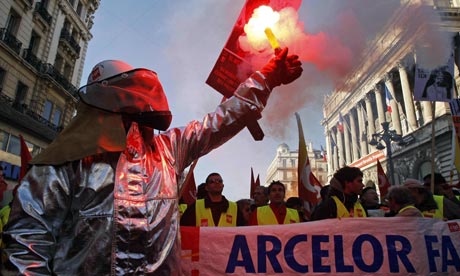
Arcellor Mittal workers demonstrate during a protest march in Marseille. Photograph: Jean-paul Pelissier/Reuters

France paralysed by a wave of strike action, the boulevards of Paris resembling a debris-strewn battlefield. The Hungarian currency sinks to its lowest level ever against the euro, as the unemployment figure rises. Greek farmers block the road into Bulgaria in protest at low prices for their produce. New figures from the biggest bank in the Baltic show that the three post-Soviet states there face the biggest recessions in Europe.

It's a snapshot of a single day – yesterday – in a Europe sinking into the bleakest of times. But while the outlook may be dark in the big wealthy democracies of western Europe, it is in the young, poor, vulnerable states of central and eastern Europe that the trauma of crash, slump and meltdown looks graver.

Exactly 20 years ago, in serial revolutionary rejoicing, they ditched communism to put their faith in a capitalism now in crisis and by which they feel betrayed. The result has been the biggest protests across the former communist bloc since the days of people power.

Europe's time of troubles is gathering depth and scale. Governments are trembling. Revolt is in the air.

Athens

Alexandros Grigoropoulos, a 15-year-old middle-class boy going to a party in a rough neighbourhood on a December Saturday, was the first fatality of Europe's season of strife. Shot dead by a policeman, the boy's killing lit a bonfire of unrest in the city unmatched since the 1970s.

There are many wellsprings of the serial protests rolling across Europe. In Athens, it was students and young people who suddenly mobilised to turn parts of the city into no-go areas. They were sick of the lack of jobs and prospects, the failings of the education system and seized with pessimism over their future.

This week it was the farmers' turn, rolling their tractors out to block the motorways, main road and border crossings across the Balkans to try to obtain better procurement prices for their produce.

Riga

The old Baltic trading city had seen nothing like it since the happy days of kicking out the Russians and overthrowing communism two decades ago. More than 10,000 people converged on the 13th-century cathedral to show the Latvian government what they thought of its efforts at containing the economic crisis. The peaceful protest morphed into a late-night rampage as a minority headed for the parliament, battled with riot police and trashed parts of the old city. The following day there were similar scenes in Vilnius, the Lithuanian capital next door.

After Iceland, Latvia looks like the most vulnerable country to be hammered by the financial and economic crisis. The EU and IMF have already mounted a €7.5bn (£6.6bn) rescue plan but the outlook is the worst in Europe.

The biggest bank in the Baltic, Swedbank of Sweden, yesterday predicted a slump this year in Latvia of a whopping 10%, more than double the previous projections. It added that the economy of Estonia would shrink by 7% and of Lithuania by 4.5%.

The Latvian central bank's governor went on national television this week to pronounce the economy "clinically dead. We have only three or four minutes to resuscitate it".

Paris

Burned-out cars, masked youths, smashed shop windows, and more than a million striking workers. The scenes from France are familiar, but not so familiar to President Nicolas Sarkozy, confronting the first big wave of industrial unrest of his time in the Elysée Palace.

Sarkozy has spent most of his time in office trying to fix the world's problems, with less attention devoted to the home front. From Gaza to Georgia, Russia to Washington, Sarkozy has been a man in a hurry to mediate in trouble spots and grab the credit for peacemaking.

France, meanwhile, is moving into recession and unemployment is going up. The latest jobless figures were to have been released yesterday, but were held back, apparently for fear of inflaming the protests.

Budapest

A balance of payments crisis last autumn, heavy indebtedness and a disastrous budget made Hungary the first European candidate for an international rescue. The $26bn (£18bn) IMF-led bail-out shows scant sign of working. Industrial output is at its lowest for 16 years, the national currency - the forint - sank to a record low against the euro yesterday and the government also announced another round of spending cuts yesterday.

So far the streets have been relatively quiet. The Hungarian misery highlights a key difference between eastern and western Europe. While the UK, Germany, France and others plough hundreds of billions into public spending, tax cuts, bank bailouts and guarantees to industry, the east Europeans (plus Iceland and Ireland) are broke, ordering budget cuts, tax rises, and pleading for international help to shore up their economies.

The austerity and the soaring costs of repaying bank loans and mortgages taken out in hard foreign currencies (euro, yen and dollar) are fuelling the misery.

Kiev

The east European upheavals of 1989 hit Ukraine late, maturing into the Orange Revolution on the streets of Kiev only five years ago. The fresh start promised by President Viktor Yushchenko has, though, dissolved into messy, corrupt, and brutal political infighting, with the economy, growing strongly a few years ago, going into freefall.

Three weeks of gas wars with Russia this month ended in defeat and will cost Ukraine dearly. The national currency, at less than half the value of six months ago, is akin to the fate of Iceland's wrecked krona. Ukrainians have been buying dollars by the billion. In November the IMF waded in with the first payments in a $16bn rescue package.

The vicious power struggles between Yushchenko and the prime minister, Yuliya Tymoshenko, are consuming the ruling elite's energy, paralysing government and leaving the economy dysfunctional. Russia is doing its best to keep things that way.

Reykjavik

Proud of its status as one of the world's most developed, most productive and most equal societies, Iceland is in the throes of what is, by its staid standards, a revolution.

Riot police in Reykjavik, the coolest of capitals. Building bonfires in front of the world's oldest parliament. The yoghurt flying at the free market men who have run the country for decades and brought it to its knees.

An openly gay prime minister takes over today as head of a caretaker government. The neocon right has been ditched. The hard left Greens are, at least for the moment, the most popular party in the small Arctic state with a population the size of Bradford.

The IMF's bailout teams have moved in with $11bn. The national currency, the krona, appears to be finished. Iceland is a test case of how one of the most successful societies on the globe suddenly failed.

(orignal article)

Wednesday, January 21, 2009

2009 Heralds “A New Age Of Rebellion”

Riots over economic crisis to escalate from March-May as Icelandic government teeters on brink of collapse

2009 Heralds A New Age Of Rebellion 210109top2

Paul Joseph Watson
Prison Planet.com
Wednesday, January 21, 2009

2009 heralds the start of a “new age of rebellion” according to an editorial in the highly influential London Times newspaper, and the year in which masses of people will take to the streets to riot in response to drastically falling standards of living.

Riot police were again deployed to combat demonstrators in Iceland last night after protesters all but stormed the parliament building in Reykjavik during its first session of chamber after the Christmas holiday. Icelandic Prime Minister Geir Haarde also became the target of an angry mob today who pelted his car with eggs.

According to a London Guardian report, the Icelandic government is now on the verge of collapse as “the first revolution in the history of the republic” unfolds.

Similar scenes have unfolded in Bulgaria and Latvia, where rapid growth has been replaced by large GDP contractions, wage cuts and unemployment. Greece was also recently gripped by some of the worst riots in its turbulent history in response to both police brutality and the economic downturn.

(ARTICLE CONTINUES BELOW)

2009 Heralds A New Age Of Rebellion 161008pptv3

According to Times columnist Roger Boyes, this is merely a “sign of things to come: a new age of rebellion”.

Boyes notes that Iceland, Bulgaria, and Latvia are not natural protest cultures and that something is worryingly amiss.

He cites the warning of respected LSE economist Robert Wade, who recently told a protest meeting in Reykjavik that the world was approaching a tipping point and that March to May would be marked by widespread global civil unrest.

“It will be caused by the rise of general awareness throughout Europe, America and Asia that hundreds of millions of people in rich and poor countries are experiencing rapidly falling consumption standards; that the crisis is getting worse not better; and that it has escaped the control of public authorities, national and international,” said Wade.

He’s not alone in his foreboding prediction. Trends forecaster Gerald Celente has echoed similar sentiments, predicting revolution in America, food riots and tax rebellions - all within four years. Celente says that by 2012 America will become an undeveloped nation, that there will be a revolution marked by food riots, squatter rebellions, tax revolts and job marches, and that holidays will be more about obtaining food, not gifts.

Boyes forecasts that Ukraine and Russia could be the next to see widespread rioting as the crisis deepens.